
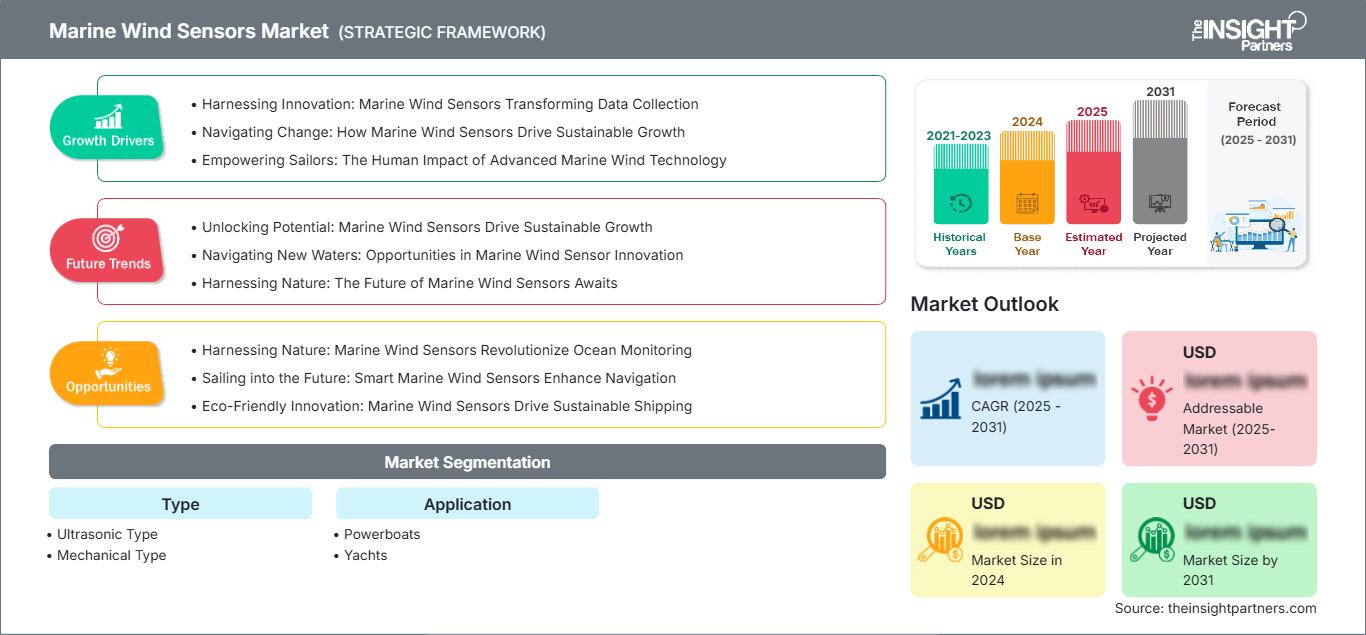
The global Marine Wind Sensors Market Size is expected to experience significant growth through 2031 as the maritime industry increasingly adopts advanced navigation and environmental monitoring technologies. Marine wind sensors play a critical role in measuring wind speed and direction, helping vessels improve navigation efficiency, operational safety, weather forecasting, and fuel management. Growing investments in offshore infrastructure, rising maritime trade activities, and the modernization of marine fleets are collectively driving demand for advanced marine wind sensing technologies worldwide.
Get a sample PDF of the Report: https://www.theinsightpartners.com/sample/TIPRE00019355
Marine wind sensors are widely used across commercial ships, naval vessels, offshore oil and gas platforms, research vessels, yachts, and fishing boats. These sensors provide real-time atmospheric information that helps operators make informed decisions during challenging weather conditions. As maritime operations become more digitized and data-driven, the importance of accurate wind monitoring systems continues to grow across the global shipping ecosystem.
The Marine Wind Sensors Market is also gaining momentum due to the increasing adoption of smart marine technologies and automation systems. Shipping companies are focusing on improving route optimization, reducing fuel consumption, and enhancing vessel performance. As a result, advanced wind sensors integrated with IoT-enabled marine systems are becoming a key component of modern maritime operations.
In recent industry developments, several marine technology providers have introduced compact and highly durable wind sensing solutions designed for harsh ocean environments. Companies are investing in lightweight materials, corrosion-resistant designs, and wireless communication technologies to improve product performance and reliability. The market is also witnessing increasing collaboration between marine electronics manufacturers and shipbuilding companies to develop integrated navigation systems.
Growing Offshore Energy Projects Driving Market Expansion
One of the primary factors supporting the Marine Wind Sensors Market is the rapid expansion of offshore renewable energy projects. Offshore wind farms require precise environmental monitoring systems to ensure operational efficiency and safety. Marine wind sensors help monitor wind conditions around offshore platforms, enabling effective turbine performance management and maintenance planning.
The increasing deployment of offshore wind farms across Europe, North America, and Asia Pacific is creating new growth opportunities for sensor manufacturers. Governments worldwide are actively investing in clean energy infrastructure, and offshore wind energy remains a key part of long-term sustainability strategies. This trend is expected to positively influence the Marine Wind Sensors Market throughout the forecast period.
Maritime Safety Regulations Supporting Adoption
The maritime industry is highly regulated, with growing emphasis on vessel safety and environmental compliance. Regulatory authorities are encouraging the use of advanced monitoring equipment to improve navigation precision and reduce accident risks at sea. Marine wind sensors help captains and operators respond quickly to changing weather conditions, thereby improving maritime safety standards.
The implementation of stricter fuel efficiency and emission reduction regulations is also contributing to market growth. Accurate wind data enables better voyage planning and optimized fuel usage, helping shipping companies reduce operational costs while meeting environmental standards.
Technological Advancements Reshaping the Industry
Technological innovation is playing a major role in transforming the Marine Wind Sensors Market. Manufacturers are developing sensors equipped with digital interfaces, wireless connectivity, cloud integration, and real-time analytics capabilities. These advanced systems allow operators to access weather and environmental data remotely, improving operational decision-making.
Artificial intelligence and predictive maintenance technologies are also gaining traction within the marine sector. By integrating marine wind sensors with intelligent vessel management systems, operators can improve fleet efficiency and minimize downtime. Such innovations are expected to create lucrative opportunities for market participants over the coming years.
Additionally, compact ultrasonic wind sensors are becoming increasingly popular due to their high accuracy, low maintenance requirements, and ability to perform efficiently under extreme marine conditions. The shift toward smart ships and autonomous marine systems is likely to accelerate demand for next-generation wind monitoring technologies.
Marine Wind Sensors Market Highlights by 2031
Market Size
- Growing adoption of advanced marine monitoring systems across commercial and defense vessels
- Increasing integration of smart navigation technologies in global maritime operations
- Rising deployment of offshore renewable energy infrastructure
Market Share
- Commercial shipping sector expected to maintain a dominant industry share
- Offshore energy applications gaining substantial market presence
- Asia Pacific anticipated to emerge as a leading regional contributor
Market Trends
- Rising demand for ultrasonic and wireless wind sensors
- Growing adoption of IoT-enabled marine monitoring systems
- Increased focus on fuel optimization and sustainability
- Expansion of autonomous and smart vessel technologies
Market Analysis
- Strong investments in maritime digitalization supporting industry growth
- Increasing regulatory focus on navigation safety and operational efficiency
- Advancements in sensor durability and real-time analytics improving adoption rates
Market Forecast
- Continued demand expected from offshore wind energy projects
- Technological innovation likely to drive product differentiation
- Expansion of global shipping activities projected to sustain long-term market opportunities
Get the Premium Research Report @ https://www.theinsightpartners.com/buy/TIPRE00019355
Global and Regional Analysis
North America
North America continues to represent a significant share of the Marine Wind Sensors Market due to strong investments in offshore energy projects, naval modernization programs, and marine technology innovation. The United States is witnessing increasing adoption of advanced marine navigation systems across both commercial and defense applications.
Europe
Europe remains a leading regional market driven by the rapid growth of offshore wind farms and stringent maritime safety regulations. Countries such as Germany, the United Kingdom, and Norway are investing heavily in sustainable maritime infrastructure and advanced vessel technologies.
Asia Pacific
Asia Pacific is expected to witness the fastest growth in the Marine Wind Sensors Market during the forecast period. Expanding shipbuilding activities, rising maritime trade volumes, and port modernization projects in China, Japan, South Korea, and India are supporting regional market expansion.
Middle East & Africa
The Middle East & Africa region is gradually adopting advanced marine monitoring solutions, particularly in offshore oil and gas operations. Increasing investments in maritime infrastructure are expected to create future opportunities for industry participants.
Latin America
Latin America is experiencing steady demand due to growing commercial shipping activities and offshore exploration projects. Market growth is also supported by modernization initiatives within regional maritime sectors.
Key Players in the Marine Wind Sensors Market
- Gill Instruments
- Vaisala
- Airmar Technology Corporation
- LCJ Capteurs
- Garmin
- Raymarine
- NKE Marine Electronics
- Calypso Instruments
- FT Technologies
- Vector Instruments
These companies are focusing on product innovation, strategic partnerships, and advanced sensor integration technologies to strengthen their market position and expand their global presence.
Future Outlook
The future of the Marine Wind Sensors Market appears highly promising as maritime industries continue to prioritize safety, automation, sustainability, and operational efficiency. The growing transition toward smart shipping ecosystems and autonomous vessel technologies is expected to significantly increase the demand for advanced wind sensing systems. Additionally, expanding offshore renewable energy projects and stricter environmental regulations will continue to create new opportunities for market participants. With continuous advancements in digital marine technologies and real-time environmental monitoring capabilities, the Marine Wind Sensors Market is projected to remain an important segment within the global maritime industry through 2031.
Related Reports –
Home Energy Management System Market Regional Share, Trend, and Growth Opportunity
Vision Transformers Market Regional Share, Trend, and Growth Opportunity
Differential-Pressure Mass Flow Controller Market Regional Share, Trend, and Growth Opportunity
About The Insight Partners
The Insight Partners is a leading market research and consulting firm delivering actionable insights through in-depth industry analysis and strategic intelligence. The firm supports clients across various industries in making informed business decisions by providing comprehensive market forecasts, competitive assessments, and growth opportunities.
Contact Us:
If you have any queries about this report or if you would like further information, please contact us:
Contact Person: Ankit Mathur
E-mail: sales@theinsightpartners.com
Phone: +1-646-491-9876
Also Available in :
Korean | German | Japanese | French | Chinese | Italian | Spanish